
I got my Bolt on July 1, 2021. Less than two months later, on August 20, 2021, GM expanded the Bolt battery recall to include my 2020 model. For those of you who don’t know, over a period of 6 or so months GM issued several recalls for the high-voltage batteries in the Bolts, eventually encompassing every Bolt ever made. In the official words of the recall, “The high voltage batteries in some vehicles may pose a risk of fire when charged to full, or very close to full, capacity.”
The battery manufacturer, LG, and GM traded blame over the issue, but the gist of the problem was that two distinct manufacturing defects were occasionally present in the high-voltage battery packs. When these two defects were present in the same battery pack it could cause a thermal event. At the time of my recall this had happened maybe a dozen times, causing quite a bit of property damage in some cases, but no deaths or serious injuries that I’m aware of. There were plenty of Bolt owners at the time who were unconcerned with the recall; and time has largely vindicated their calm. However, receiving that recall kicked off 3 months of stress and uncertainty for me.
The most concerning aspect of the recall was that, for a long time, GM could offer no clear timeline on a fix and only offer guidance to mitigate the risk of fire, not prevent it. After a software fix that didn’t work, GM eventually decided that all of the battery packs would need to be replaced. With somewhere around 140,000 cars affected this was clearly going to take a while. In the meantime, here is the guidance we were given:
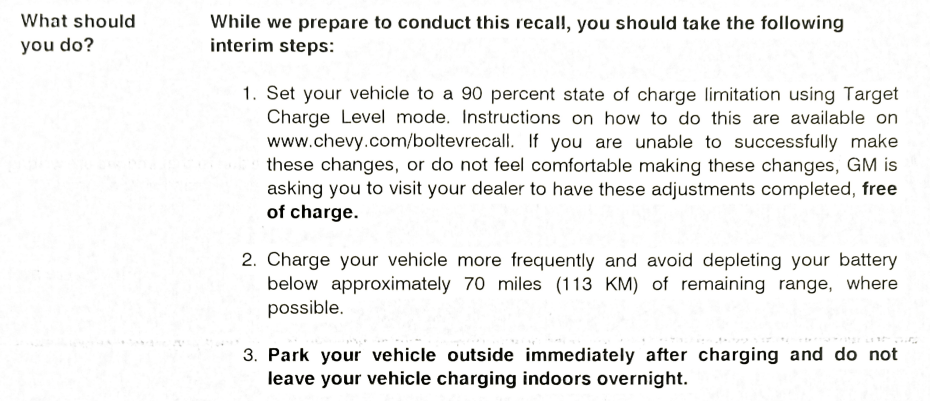
In mid-November I received an update saying a diagnostic software package was being rolled out that would limit the car to an 80% charge, but remove the other two restrictions. About a month later I received a notice that I could go to a dealer and have the software installed. By that time I no longer had the vehicle.
Living with a Tinderbox
So after just a couple of months of ownership, now it’s unsafe to charge my car near any flammable structure and I can only use 60% of the battery. This posed a problem: I only had level 1 charging at home, so I had to charge overnight, and the car needed to be in or next to my garage to do so. Even worse, I live in a row of connected townhouses, so if ours went up in flames then so would everyone else’s. As a courtesy I talked to my next door neighbor about the recall and the precautions, and I could tell a few of my other neighbors had read about it online and were looking warily at my car whenever I parked elsewhere in the neighborhood. Fortunately, this was the extent of the persecution I experienced – there were plenty of stories online of parking garages, apartments, etc. banning Bolts entirely, which I’m sure caused issues for Bolt owners.
I was at a crossroads. I could obviously just wait it out – a fix was coming and the odds of a thermal event happening under the restricted usage were extremely unlikely – or I could try and get rid of the car. Waiting an indeterminate amount of time was unacceptable to me, so I started looking into the second option. While I was genuinely concerned about my car catching my house on fire, my reaction to the recall honestly had more to do with my feelings toward the car at the time I received the notice.
Buyer’s Remorse
As I hope my review illustrates, I really do think the Bolt is a good car. However, in the month after I bought it I really started to wonder if I’d made a good decision. Ultimately I think this all stemmed from the price I paid and my experience with the dealership. Despite shopping for a while, I pulled the trigger in kind of a hurry because Bolts were starting to sell out from under me. I found a discounted new one that was a year old and I had a whole back and forth with this dealership over the phone and email where they promised me one price and then walked it back. I ultimately convinced myself the new price was still acceptable. Going to the dealership to test drive and purchase the car did not make me feel any better about the dealer. It was clear they didn’t know much about the car and just wanted to get me out the door with it. (As just one example of the dealership’s carelessness: they never registered the car as sold to me with GM. Initially this just meant I never got the $500 accessory voucher or whatever deal they were running at the time. More importantly, though, it meant that I didn’t get a recall notice from GM because they didn’t know I owned the car. If I was an owner who didn’t use the app and didn’t have a news feed full of EV news who knows how long it would have taken me to find out about the recall.)
After months of research making me excited about the car, the process of actually getting it soured me a bit. Out the door I paid $32,415.74 (including sales tax, fees, etc.). This was when the Bolt did not qualify for the tax credit, so that was the net price I paid. At the time it wasn’t necessarily a bad deal for the Bolt, but relative to current prices on the refreshed model, or back when it was a fresher EV to begin with (and in both situations qualifying for the $7,500 tax credit), it didn’t feel like a great deal. The other exacerbating factor was buying another new car at exactly the same time. That car, a Subaru Outback, was only $4k more (fresh from the factory, no discount), so I couldn’t help comparing the two. Despite the fact that I immediately feel in love with electric and never wanted to drive a gas car again, the Outback just felt like so much more car for the money, and the dealer/manufacturer experience was just night and day. Little things about the Bolt started to bother me more and more…
So it was with that baggage that I reacted when I received the notice that my car could catch on fire. After seeing some people online opting for a buyback, I took it as an opportunity (albeit a stressful one!) to have a do-over on the car.
The Buyback Process
I scoured the forums, but there was no consistent framework for how to get a buyback or who was eligible. The best one could hope for was to initiate the process and stay on top of it, so that’s what I did. I don’t recall all of the steps, but it started with a phone call and continued over email and phone for several months. Concurrent with that, I joined a class action lawsuit as a backup in case the buyback didn’t go well.
With the situation behind me I can say that the buyback process wasn’t too bad. It resolved in a reasonable amount of time without me having to jump through too many hoops. The offer ended up being just $500 under what I paid for the car, which was fair since I had put 2479 miles on it. In the context of “renting” the car for 4 months, $500 seemed reasonable.
Gone in a Flash
I did struggle with the decision at the end. Part of me worried I was giving up a perfectly good car, and for what? To head back into the wilderness that is car shopping? However, the case for keeping the car wasn’t strong enough. Owners of 2017-2019 cars were getting a fresh battery with a fresh 8 year warranty, plus a slight capacity upgrade, and were probably already attached to their car. I, on the other hand, hadn’t had the car long enough to become attached and only stood to get back the car exactly as I bought it. I figured I could always just buy another Bolt if I regretted giving it back.
So I sold it back to GM, dropped out of the lawsuit, and dusted my hands of the whole affair. It was a relief, but it was still difficult to go back to sharing a car and be faced with an even bleaker affordable EV marketplace, while now being fully hooked on EVs. With the benefit of hindsight, I do feel good about my decision. That Bolt was not the best purchase for me and I am grateful that I got a mulligan on it.
 Miniwatt Auto