
The Set Up
We take a weekend trip to Houston averaging about once a month. I had that drive squarely in mind when purchasing the Bolt, but knew when I got the Mini it was mostly out of the question. At first I wasn’t too bothered by that. On paper our Outback is great for that trip – it’s got adaptive cruise control and lane centering, plenty of space, and it gets about 30 mpg on the highway. However, I just couldn’t get over the disappointment of not being in an electric car every time we made that drive, so finally, in March 2023, I resolved to give it a go in the Mini.
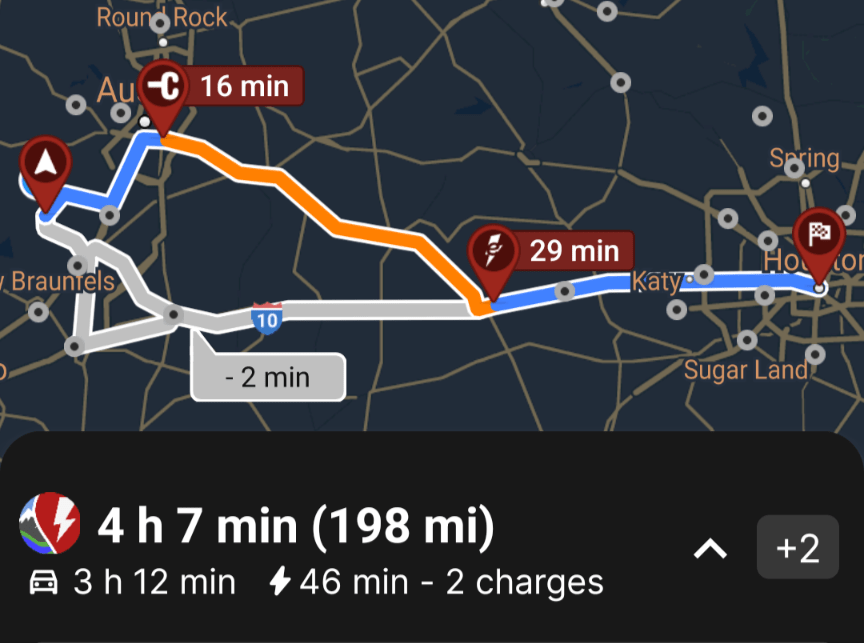
I knew it was technically possible, but the drive is almost 200 miles and chargers are sparse. Between Plugshare and A Better Route Planner (ABRP) I’d explored it from every angle and decided there was really only one viable route option. The western half of the trip is the tricky part; closer to Houston the chargers are (slightly) more plentiful, but to even get that far I’d have to go through a stretch that would push the limits of the Mini’s range.
Our normal route takes us to Luling, then it’s a straight shot on I-10. It takes about 3.5 hours with the usual traffic. Since we generally head out after work on Friday that means we’re arriving late under the best circumstances, so taking longer is not good. Unfortunately, on that route there’s a 99 mile stretch from San Marcos to Columbus with no fast charger in between. The Mini is rated at 114 mile range, but at least half of that stretch has a speed limit of 75 mph and I doubted the Mini was capable of that range at those speeds. That left a razor thin margin for error, if any. ABRP was equally pessimistic, short of going <55 mph on the interstate. So that meant my route would have to be this…
Going this way shortens the max distance between chargers to 85 miles. As you can see by the yellow, ABRP still thinks that requires keeping it under the speed limit, but by about 5 mph instead of 25 and that’s to arrive at the charger with at least 10% remaining. ABRP generally seems pretty conservative on the default setting, so I was pretty confident this was doable. (Note: if I had some accurate efficiency data I could have done more precise calculations, but up to this point I’d never driven the Mini at a sustained 65+ in order to gauge that consumption.)
When mapped, this route up through Austin adds about 10 minutes, but the first charger is located at the Austin airport and in reality it adds around 30 minutes – so even without charging time the trip is longer. The second disadvantage of this route was that same charging location: it consists of two Chargepoint units. Overall I have found Chargepoint to be the most reliable fast chargers, but not so for these ones. I tracked them on Plugshare for months leading up to the trip and one was persistently out of order. That meant I was relying on a single charger in a heavily trafficked area. Finally, the distance between these two chargers would mean charging well above 80% to safely make it. The Mini’s meager max charge rate of 50kW is somewhat offset by the fact that it jumps up to that rate immediately and holds steady, but like any EV the charge rate steadily declines after 80%, adding to my charging time.
The Trip
So I had a route plan and I knew the pitfalls. All that was left was to find the right time – I needed a weekend when we could spare the extra time on the road and weren’t going for anything too important to miss in case it all fell apart. Eventually the right weekend came around and I went for it…
To Houston
We left on a Friday after work, like usual. I went up through Austin to the first charging stop at the cell phone lot at ABIA. This was a stressful stop. The chargers are in the middle of a parking lot that is always full and constantly has cars coming and going. I knew the odds weren’t great that the one working charger would be free. When I arrived I pulled into the one available charger, not sure if it was the working one or not. I quickly discovered it was not. However, the person parked in front of the working one was not charging and when I asked if I could use it she moved. (Etiquette note: charging spots are not like handicapped spots – just because you are in an EV doesn’t mean you should park there. They are meant for people who are charging. It has not inconvenienced me often, but I’ve seen enough EVs using charging spots as parking spots that it bears mentioning.) After she moved I had a tense minute navigating around the parking lot hoping no one would swoop in. Fortunately I was able to get the spot.
1st leg summary: nothing to report. Going into Austin is a common trip for the Mini.
1st charging summary: I charged there from 65-99% which took me 29 minutes and cost $6.24 at $0.21/min.
From there to Columbus was the most nerve-wracking leg. For the first half the speed limit was a mix of 65 mph and under. The second half was mainly 75 and my efficiency took a noticeable hit with the higher speed. I ended up dropping my speed from 80 to 75 because I was worried about consumption, but made it without issue.
The charging stop in Columbus is a small Electrify America station at a nice gas station. There are four chargers: a 150kW unit with CCS and CHADEMO, then a 50kW unit, 150kW unit, and a 350kW unit, all with CCS only. Watching Plugshare leading up to the trip I noticed it was common for 1-2 of these units to be out of commission at any given time. Sure enough, I found the 350kW unit covered in red tape and another unit’s screen was blank, but some nice person left a note saying you could still use it through the app. There was only one car there when I arrived, so I did not have to wait for a charger.
2nd leg summary: in total I averaged 3.4 miles/kWh and traveled 85.2 miles. I went from 99-15%.
2nd charging summary: I charged from 14-92% in 40 minutes. At $0.19/min it cost me $8.02.
I was able to make it to our first stop in Houston without charging again. Most of that drive is on I-10, but between construction and city traffic I was generally going slower than the speed limit, so my efficiency was better on this leg. Where we stayed I was able to plug into a 110v outlet overnight. This wiring was a lot newer than mine at home so for the first time I bumped the Mini’s level 1 setting to the max amperage, which made a significant difference.
Final leg summary: this drive took me from 92-30%, after traveling 74.1 miles and averaging 3.8 mi/kWh.
Final charging summary: this is not public charging, but it’s interesting. At the max amperage setting I charged from 29-74% (18kWh) in 14h 48min, a charge that takes me 6 1/2 hours longer on the middle amperage setting.
Back Home
Over the weekend we drove about 50 miles. I opted not to plug in Saturday night, which I regretted – it would have eliminated one of the first two charging stops I made on Sunday. There was a public level 2 charger where we spent Sunday morning, so I used that for 2 hours, but it didn’t give me enough juice to avoid a brief stop at a fast charger during our first leg home.
1st leg summary: since this first leg was not how I would normally structure the return trip I did not record any data for this leg.
1st (2) charging summary: at the level 2 Blink charger I charged for 2 hours and got from 13-53%. I was charged $5.16. I then stopped at an EVgo station in Katy and charged for 17 minutes from 33-72%, for a total of $7.16.
Again, I did not track stats for the drive from there to Columbus because I did not foresee doing this exact leg again. Charging at the EA in Columbus on the way back was eye-opening. The 350kW unit was of course still out of service and two of the other units were occupied, but I was able to pull into the fourth one and start charging. However, almost immediately, more EVs started pulling up and there were quickly 4-5 cars waiting to charge. Most of the cars charging spent about 30 minutes, so it was not a quick turnover. Also, the layout of the lot did not allow cars to form a clear queue, so I could foresee issues with people not using the chargers in the order in which they arrived. This stretch between Austin and Columbus used about 85% of my battery on the way out and I knew it was slightly uphill heading back, so I really needed a full charge to safely make the trip. This was excruciating for me because with several cars waiting, and anyone who wanted to able to see that I was charging above 90%, those last few percentage points felt sooo long. It is worth mentioning though that no one was rude, everyone seemed understanding or at least resigned to wait, and I was even able to chat with a few other drivers. (Side note: when I pulled into the empty 150kW unit I saw a Porsche Taycan charging at the 50kW unit next to it. When I mentioned to him he could be charging faster, he seemed not to be aware there was a difference between the units. I don’t think every EV driver needs to be an EV expert, but it does show that a basic understanding, including your car’s charging capability and the different types of chargers, goes a long way. Conversely, charging at a faster unit than your car can accept when a more appropriate one is available is a faux pas that I think drivers should know to avoid.)
2nd leg summary: nothing to report. Went from 72-21%.
2nd charging summary: I charged from 21-99% in 47 minutes. At $0.19/min it cost me $9.56.
Despite slight elevation gain the return leg between Columbus and Austin was surprisingly more efficient than the trip out. This was partly due to traffic at the end, but my efficiency seemed the same or better in the faster sections too. Once again I got lucky securing the one working charger at ABIA and completed my last charging session without issue.
3rd leg summary: I traveled 83.9 miles and averaged 3.7 mi/kWh. When traveling 75-80 mph I did 3.5-3.4 mi/kWh, respectively. I went from 99-22%.
3rd charging summary: nothing to report. I didn’t need more than 50% to make it back comfortably, so I did a quick charge and went home.
The Takeaway
I was very excited to do this trip in the Mini and overall found it a fun exercise. That being said, I recognize the trip was objectively less convenient in the Mini compared to our Outback and the average driver would not accept the drawbacks, let alone consider them exciting “challenges”. Even I was compelled to admit, after the satisfaction of completing the trip, that I did not want to do it again until better charging options were available. A bit of extra time spent charging is inevitable, but having to take the longer route is an unnecessary inconvenience and being forced to charge at the top of the battery pack makes it worse. It added about 1.5 hours each way. The additional stress of hoping for an open charger or feeling the people behind you waiting as you creep toward 99% at these locations with few working chargers was probably my least favorite part.
To add insult to injury, I was disappointed to add up all of my charging stops and discover the electricity was not much less expensive than gas in the Outback. All of my charging sessions added up to $39.51, which is just a few dollars shy of a tank of gas that will easily get us to and from Houston. Granted, that’s when gas is cheap – there have been plenty of times when that gap has grown to over $10 – and doing a couple of full charges at per minute chargers added quite a bit. Electricity cost (within reason) is not a major factor for me, but because I spend so much time charging at home where I don’t even notice the impact on my electricity bill, or at the free fast charger in town, I was expecting a road trip to be dramatically cheaper too.
The Future
About nine months have passed and I am itching to take the Mini to Houston again, but unfortunately the charging options are not much improved. Quite a few new locations have popped up on the eastern half of the route, but that section was never the issue. I have watched a couple of well-placed locations pop up on Plugshare as ‘coming soon’ only to languish for months and eventually be removed. Honestly, this has been the most disheartening aspect of owning an EV to me. In the face of all the other perceived impediments to EV ownership I’ve maintained enthusiasm and a feeling that they are overblown, but watching the slow pace and unpredictable nature of these charging station roll-outs has got me down. I just want to be able to drive electric more often!
Things are looking up though. There is now a fast charger in Luling that would technically allow the Mini to make the trip along our usual route, but it’s at a dealership, only accessible during business hours, and those hours don’t align with when we’d normally need that charger. There is also a station coming soon at a Pilot in Schulenburg and with Pilot/GM opening a couple dozen stations across the country recently I’m hoping this one will move quickly. When Tesla started adding the CCS adapter to its Superchargers I was thinking the Flatonia Supercharger station was going to unlock this route for me, but only one Texas station has added CCS since then and I don’t know what the shift to NACS means for future CCS Superchargers. However, the Shell Recharge station in Flatonia that was ‘coming soon’ forever and then disappeared from Plugshare now seems to actually be underway. It is still not on Plugshare but I stopped there last weekend and saw some chargers clustered in the parking lot waiting to be installed. Once one of these options comes online I should have the right locations to complete the trip along our normal route at full speed with just two stops, neither requiring a full charge. I’m anticipating only adding about 45 minutes each way and possibly costing less too. We shall see!
 Miniwatt Auto