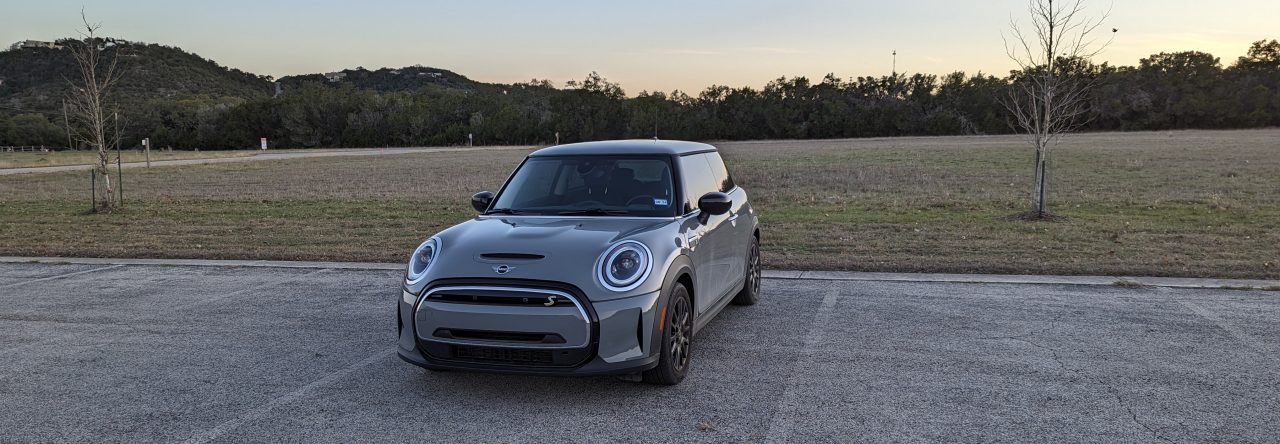
This Central Texas summer has been much cooler than expected overall. But that does not mean that we haven’t had some stretches of 100+ days. Most of the conversation about how ambient temperature affects EVs centers around the extreme cold. However, any temperature outside the 50-85 Fahrenheit that most batteries prefer is going to have adverse effects. Here is my experience driving my Mini Cooper SE in hot weather.
Range does suffer. I have not pinned down an exact calculation, but it seems like it’s about a 5-10% reduction when the temps are nearing 100. The biggest drain comes from cooling the cabin, so your experience will vary greatly based on a number of factors. For example, are you driving during the hottest part of the day? Do you park in the shade or full sun? How tinted are your windows? You get the picture…For one or two trips per day this drain would probably not be noticeable, but it does compound. If you take a lot of little trips on a hot day, with the car sitting in between, you will find that your battery does not go as far as you are used to. I recently got into a close call that was eye-opening.
It was around 2pm and 95-100 degrees. I left home at 40% and needed to get to Austin. That’s generally about what that trip takes, but I needed some extra for driving around town. My options were to go a bit out of my way and use the free charger in town or hit up the first charger in Austin. Free sounded pretty good, so I opted for that. For the first time ever, that charger failed to work and when I finally gave up and got back in the car I realized I’d burned a surprising amount of battery getting there and keeping the car cool for the 5 minutes I spent trying to charge. As I headed towards Austin I realized I might not have enough battery to get to the nearest charger in Austin, so I detoured to Kyle.
This is where things got more dire than I expected. The ever-reliable Chargepoint station in Kyle was completely down, something I fortunately figured out before arriving. That left one XCharge unit that is more of a demonstration unit open to the public than a reliable charging stop. I arrived there at 17% – not enough to confidently get me to any other fast charger. It took me several tries to start charging, making me think I’d be looking for a level 2 charger to sit on for a couple hours, but it finally worked. I charged again in Austin before heading home but had no other tense moments, either with range or charging, the rest of the day.
During my first charging session I realized that I was not getting AC while fast charging. I have never noticed this and swore that I had fast charged before with AC on. I assumed it was so hot that perhaps all of the cooling was going to the battery or had been cut for some other reason. When I charged later that night I confirmed that it was only blowing ambient air while charging. I finally looked it up later and learned that you have to turn on Comfort Climate in order to get AC while charging, since the car will not “start” while plugged in. I guess during past hot weather charging sessions I happened to have Comfort Climate on. But that is an invaluable bit of knowledge if you are charging in the summer; not only if you are sitting in your car, but also to precondition so that you’re not wasting the juice you just put in cooling the car once you unplug.
When it gets really hot you should also be more conscientious of your state of charge when parking your car. Heat can be damaging to a full battery that’s left sitting, so stay well within your manufacturer’s charge limit recommendation if you want to extend your battery life, especially if you’re going to just drive a short ways and park it in the sun for 8 hours.
It should be mentioned that Nissan Leafs have historically struggled with the heat more than other EVs because their batteries do not have active cooling. Early Leafs in hot cities like Phoenix were dying premature deaths, so much so that the battery chemistry was changed to be more heat tolerant. I believe this mitigated much of the issue, but I don’t know how much. I also read several accounts of Leafs struggling to fast charge in the heat, due to the battery overheating. I do not want to fear-monger or steer you away from a Leaf, but do some extra research if you are considering owning a Leaf in a hot climate and make sure you check the battery health if you are buying one that lived in a hot climate.
Driving an EV in the summer is not all cons, however. That same preconditioning that drains the battery is well worth it when you leave work and get into a cool cabin instead of an oven. And while most modern ICE cars can be remotely started to cool down, I don’t know of any that let you schedule it in advance. I’ve got mine set to be comfortable when I leave home in the morning and work in the afternoon.
Winter weather gets most of the attention when it comes to EVs, but there are things to be aware of when the temps get high too. Don’t let any of this deter you. I see it as only a minor inconvenience and a car with more range should have no issue at all. So enjoy your EV and stay cool out there!
 Miniwatt Auto