
A few weekends ago the right opportunity finally presented itself to take the Mini to Houston again. Our itinerary took us straight to the west side of the city and back: no extra trips around town or to the suburbs that would add charging stops. Several new charging sites have opened since my last epic journey to Houston and we can now take our usual route. Here is the planned route to Houston:
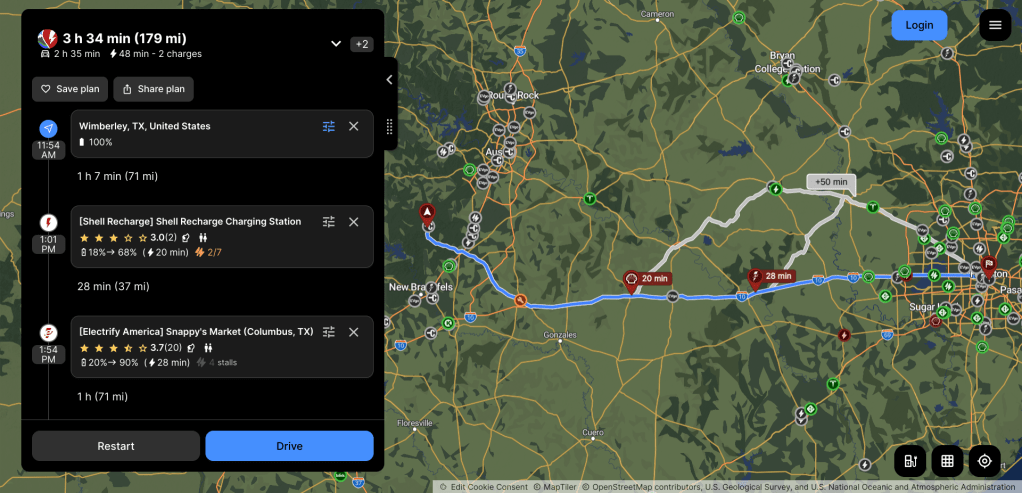
The planned route back was similar but ABRP added in a third stop close to home since I did not want to charge above 90% in Flatonia.
To Houston
It was raining slightly before we set out, which was a variable that I did not appreciate. It was unclear how much rain I might be driving through, and even more unclear how that might affect my efficiency. People online seemed to report anywhere between 2-10% range reduction in the rain, but that obviously depends on a lot of factors. In the end, the drizzle that I drove through did not seem to have much effect.
1st Leg Summary
- Miles traveled: 85
- SOC: 100% –> 18%
- GOM: 13 miles of range remaining at charging stop
- Efficiency: 3.5 mi/kWh
1st Charging Stop
This Shell Recharge site in Flatonia was the pivotal charging stop. There was no skipping it and no backup. I had issues with a Shell Recharge station a month before and was desperately hoping it was a one-off. Sadly, no. All stalls were open when I arrived, so I plugged into one of the 180kW units. It charged up to 36% and then abruptly stopped: the same issue I had at the last Shell station. I tried the other cable, and then both cables on another 180kW unit. I got about 1% charge each time. I maybe had enough juice to limp to the next station but it would be harrowing. I was getting a bit nervous and a lot wet from the rain. I called the help line but ended up on hold for 20 minutes. In the meantime I plugged in to the single 350kW unit and thankfully it charged fine. I felt bad occupying the fastest charger there but it didn’t take long for me to charge enough for the next leg.
2nd Leg Summary
- Miles traveled: 36.6
- SOC: 67% –> 28%
- GOM: 25 miles remaining range at charge stop
- Efficiency: 3.1 mi/kWh
2nd Charging Stop
This EA station was one I used last time and despite always having one unit offline it’s quite reliable. It did not disappoint: I was able to charge up without issue.
3rd Leg Summary
- Miles traveled: 55
- SOC: 77% –> 23%
- GOM: 21 miles remaining range at destination
- Efficiency: 3.5 mi/kWh
- Average speed: 33.1 mph
Destination
We arrived at our destination 4 hours after we left, which is about an hour longer than it should take driving straight through. I did not have access to a level two charger at our destination so I did have to visit a nearby fast charger to get up to 81% for the start of the return trip.
To Home
1st Leg Summary
- Miles traveled: 54
- SOC: 81% –> 22%
- GOM: 18 miles remaining range
- Efficiency: 3.2 mi/kWh
- Avg speed: 64.7 mph
1st Charging Stop
I stopped at the EA in Columbus again and used the same charger I did on the way out; no issues. But now I had a decision to make: should I go back the way I came and rely on the one 350kW Shell charger to work again, with no backup, or change the route and go up to Bastrop to try out the magic dock-equipped Tesla Supercharger site there? That was also an unknown variable, since I had never tried a Supercharger before, but it had a ton of stalls, so no availability concerns, and Plugshare showed a Ford dealership nearby with an available fast charger. Dealerships are never a preferred option but that’s better than no backup.
2nd Leg Summary
- Miles traveled: 61
- SOC: 86% –> 16%
- GOM: 70 –> 12 miles remaining range
- Efficiency: 2.9 mi/kWh
- Avg speed: 74.8 mph
2nd Charging Stop
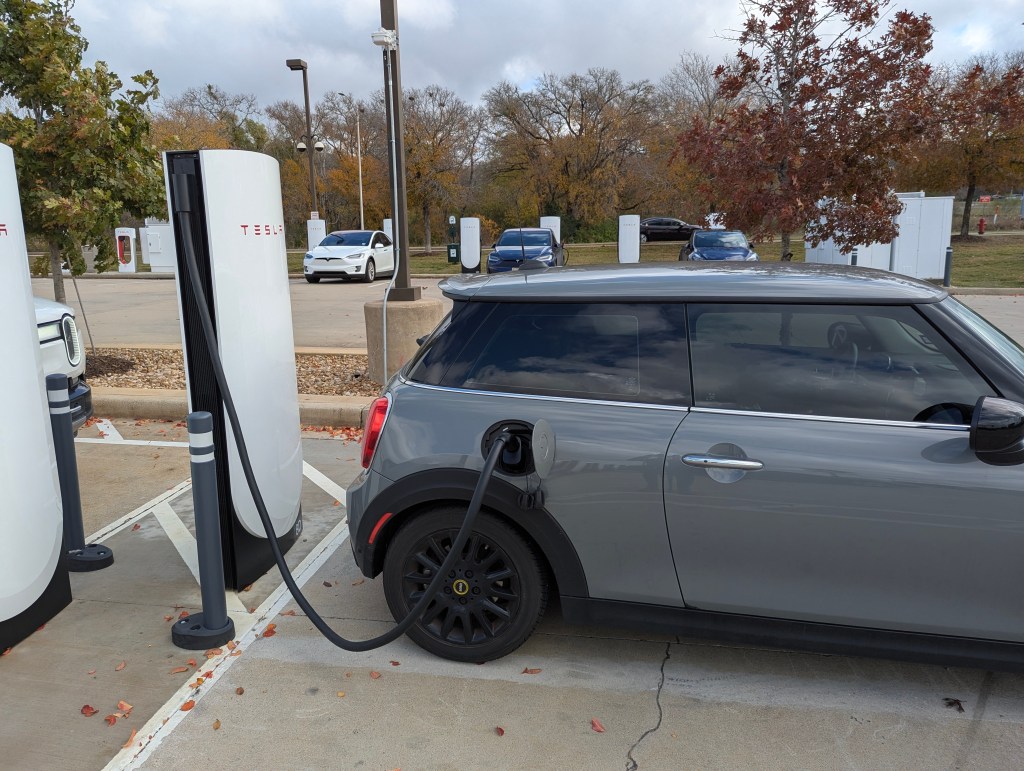
I decided the Supercharger was a safer bet than the Shell station, so I changed the route and went to Bastrop. While I try to avoid Buc-ees (where this Tesla site is located) because of the crowds, the Superchargers were fortunately located in a less-trafficked area of the parking lot. I had plenty of stalls to choose from: 32 total with only 1 out of order and a handful in use. I parked at one of the V4-style dispensers so I was able to use the intended parking space. Although I already had the Tesla app it took maybe 5 minutes for me to add payment information and follow the steps to use the magic dock. However, it worked flawlessly the first time I plugged in. Our final leg was about the same distance as the one just traveled but at a slower speed so I was pretty confident that I could skip the extra little stop and go directly home if I charged over 85%.
3rd Leg Summary
- Miles traveled: 62
- SOC: 89% –> 28%
- GOM: 72 –> 26 miles remaining range
- Efficiency: 3.7 mi/kWh
- Avg speed: 39.8 mph
Final Thoughts
Not counting an extra stop for food, the trip back took a little over 4 hours, so again about an hour longer than necessary. I believe when a new site opens a bit closer to home – Luling, for example – total stop and charge time can be cut to 45 minutes each way if our destination is on this side of Houston. However, we often drive to suburbs north and south of the city, which would certainly add more charge stops and really make the Mini an inconvenience. However, this trip confirmed another negative: cost. All of the charging sessions for the trip totaled $51.49, which is at least $15 more than it would have cost in my Outback with the current gas prices. With so little of the total kWhs used coming from home charging the Mini starts out at a disadvantage, and then not being able to pick and choose the stations with the cheapest rates, or rely on one network where you can buy down the rate with a membership, the costs just stack up. Although the inconvenience of so many charge stops is what will keep us from using the Mini for this trip very often, the surprisingly high cost was the biggest disappointment. Tesla has some of the most competitive kWh rates I’ve seen so I’m hoping that will put pressure on the other providers to lower their cost as the Supercharger network opens up.
 Miniwatt Auto